A Rosh Hashanah 5784/2023 Sermon by Leah Julian
When the Barbie Movie came out this past summer I rushed to the movie theater. A lifelong Barbie devotee I was thrilled to watch my favorite childhood toy brought to life on the big screen. I had few expectations of the film other than I expected to like it because come on- it’s Barbie!
What I did not expect was just how much I would like it. Yes, it’s colorful and upbeat, there are large choreographed dance numbers, and that’s not to mention the star studded cast. But more than that, the Barbie Movie is deeply moving. It touches on so many important themes- the complexities of being a woman in today’s world, gender equality, patriarchy, body shame, women’s empowerment, aging. I could go on and on. Perhaps what moved me the most though, was that a movie about a doll is fundamentally a meditation on what it means to be human. Let me explain.
Without giving too much away there’s a scene towards the end of the film where Barbie is in this limbo space between Barbieland and the “Real World.” Having saved Barbieland from Patriarchy and essentially fulfilling her purpose as a doll, Barbie stands at a crossroads between a life that was, and a life that could be. She has an important choice to make: Does she stay in the past? Or does she move forward?
In this scene Barbie is in conversation with the ghost of Ruth Handler, the creator of Barbie. Barbie tells Ruth that she thinks she wants to be human. Taken off guard, Ruth says: “you understand that humans only have one ending. Ideas live forever. Humans not so much. You know that right? Being a human can be pretty uncomfortable. Human beings make things up like ‘Patriarchy’ and ‘Barbie’ just to deal with how uncomfortable it is…and then you die!” Despite all of this, Barbie presses on. “I want to be part of the people that make meaning” she says. “Not the thing that gets made. I wanna do the imagining. I don’t wanna be the idea.” In this moment Barbie identifies one of the key aspects of being human– we make meaning. We have ideas. We imagine things. We make connections between our thoughts and feelings and experiences to help us make sense of the world around us and our place in it. We create worlds in our minds to help us cope with what Ruth describes as “the discomfort of being human.”
Barbie is definitely not the first to identify making meaning as a central aspect of human existence. In 1946, Jewish Viennese psychiatrist and Holocaust survivor Dr. Viktor Frankl wrote about this topic. In his beloved classic Man’s Search for Meaning Frankl writes: “striving to find meaning in one’s life is the primary motivational force in man” (p. 99). Although not the first to talk about the central role of making meaning in the human experience, from his vantage point as a physician, researcher, and concentration camp survivor, Frankl’s life and research is a powerful testament to this.
“There is nothing in the world, (said Frankl) I venture to say, that would so effectively help one to survive even the worst conditions as the knowledge that there is a meaning in one’s life. There is much wisdom in the words of Nietzsche: ‘He who has a why to live for can bear any how….’ In the Nazi concentration camps, one could have witnessed that those who knew that there was a task waiting for them to fulfill were most apt to survive.” (p 104)
What Frankl is saying is that as long as someone had a reason to keep going, had even the smallest inkling that their life mattered in some way, they could survive the most unimaginable of conditions. Frankl himself said that it was thoughts of seeing his beloved wife again and continuing his research that helped him endure hunger, cold, disease, and unremitting labor.
While Frankl’s example is extreme, the lesson he learned — and the topic he devoted his life to studying and teaching — is one that is relevant to all experiences and at all times, but especially this time of year. It’s Rosh Hashanah. The beginning of the Yamim Noraim, and our communal season of reflection. I cannot think of a more perfect time to bring to bear what both Barbie and Frankl have to teach us about the human experience– that above all else we seek to find meaning in our lives. During the Yamim Noraim we are asked to look at our lives in their fullness. To see the ways in which we fell short this past year as well as the times we lived up to our highest potential. We are asked to make commitments to how we want to move forward so that over the next year we may strive to be the best versions of ourselves. In other words, we are asked to make some kind of meaning out of our lives.
To be clear, I am not saying that during these ten days we are supposed to find THE meaning of life because there probably isn’t one overarching capital M Meaning of Capital L Life. That’s not how the universe works. I am also not saying that during the Yamim Noraim we are supposed to find the overarching meaning of each of our individual lives because again, there probably isn’t one. As Frankl understands it:
“What matters…is not the meaning of life in general but rather the specific meaning of a person’s life at a given moment. To put the question in general terms would be comparable to the question posed to the chess champion: ‘Tell me, Master, what is the best move in the world?’ There simply is no such thing as the best or even a good move apart from a particular situation in a game and the particular personality of one’s opponent. The same holds for human existence.” (p. 108)
In other words life has infinite possible meanings at any and every moment. And these meanings can change from moment to moment. Meaning, just like life, is not static. It all depends on who we are and the situations we find ourselves in. It is our job to discern for ourselves what it is that gives our lives meaning each and every day.
For instance, Barbies were incredibly meaningful to me as a child because they were a vehicle through which I could play out my imagination. As I got older and outgrew imaginative play, Barbies took on another meaning: they were reminders of an immaturity that had to be “put away” if I were to be taken seriously as a “real” mature adult person. And as I have continued to get older, Barbies have taken on yet another meaning. Because of the Barbie Movie I have come to see Barbies as important symbols of the power of imagination and how fundamental it is to human existence. The meaning I have ascribed to Barbie throughout my life has changed because I have changed- but that does not mean Barbie ever ceased to be meaningful.
Meaning can be found everywhere, but Frankl identified three general categories of sources of meaning: 1) work, 2) relationships, and 3) suffering. The first two sources are somewhat self explanatory, but the third one, not so much.
Suffering is an inescapable fact of life. All of us, at some point in our lives will find ourselves in difficult situations that cannot be changed. Frankl reminds us that “when we are no longer able to change a situation… we are challenged to change ourselves” (112). The experience of suffering gives us the opportunity to turn tragedy into triumph by helping us see that even under the worst of circumstances life is still infinitely meaningful. Suffering need not lead to degradation or despair. If we choose to find some higher meaning in our experience, then we have the opportunity to be ennobled by our burdens. Aren’t we in awe of the person with incurable cancer who nonetheless finds reason to laugh and sing? Aren’t we in awe of the paraplegic who becomes an olympic athlete? We are so in awe of these people because they have chosen to continue to find meaning in life despite their challenges. They could easily give up, but instead they choose to rise above the hardships life has thrown their way and turn their tragedy into triumph. No matter the challenges we may face, we are all capable of triumphing in this way.
The fact of human suffering reminds us that life is unpredictable and at times completely out of our control. The High Holy Day liturgy passed down to us throughout the ages is all too aware of this fact. One of the piyyutim (pieces of creative liturgy) we sing during Selichot goes “As clay in the hand of the potter, who thickens or thins it at will, so are we in Your hand, Guardian of Love.” Verse after verse compares God to an artisan of some kind, and humans to the materials used by that artisan. While the verses are different, the refrain is the same: לברית הבט ואל תפן ליצר. “Recall Your covenant, do not destroy your creation.” The piyyut describes what the writer saw as the fragility of human life and asks the Divine Artisan to deal kindly with their creation. In one sense, this piyyut imagines human beings as the play things of God. We are completely under God’s control, and we live at the whim of God and the only thing we can do is to beseech God to deal favorably with us. Not unlike a Barbie we are God’s play things. We live and die by God’s word.
While I appreciate the imagery used in this piyyut, and the overall message of life’s fragility, I don’t agree that the only recourse we have is to beseech God for mercy. The Barbie Movie and Viktor Frankl teach us that while we may not be able to control much, we are in control of how we respond to what happens to us in life. We have the power to live meaningful lives despite the circumstances that befall us- because only we are in control of our minds and imaginations. Our capacity to learn and grow regardless of what hardship we face, is not just human, it’s what makes us human. Frankl reminds us:
“To be sure, a human being is a finite thing, and his freedom is restricted. It is not freedom from conditions, but is freedom to take a stand toward those conditions. As I once put it: ‘As a professor in two fields, neurology and psychiatry, I am fully aware of the extent to which man is subject to biological, psychological, and sociological conditions. But in addition to being a professor in two fields I am a survivor of four camps – concentration camps, that is – and as such I also bear witness to the unexpected extent to which man is capable of defying and braving even the worst conditions conceivable.” (130)
Throughout these High Holy Days we will be confronted by religious imagery in our liturgy that may or may not speak to our modern sensibilities. Whatever words are used, the basic message behind most of it, is that life is fragile and unpredictable. I think we can all get behind that message. While the liturgy will tell us that the best way to deal with this is to have faith in God, the message of the Barbie Movie and the life and work of Viktor Frankl teach us that even though life is fragile and unpredictable there is still meaning to be found in it. Regardless of life’s circumstances it remains infinitely meaningful and worth living. We all cope with life’s uncertainty differently. For some of us it is faith in God and for others it’s knowing that we have the power to transform our burdens by finding meaning in them- because after all there is meaning to be found in everything.
We are in a very meaningful time of year. There is much meaning to be made. As you participate in services, listen to the blast of the shofar, sit with family and friends over holiday meals, cast out your misdeeds during Tashlich, and spend time reflecting on your own– I hope you will meditate on the fact that no matter who you, where you are in life, and the circumstances you find yourself in– your life is meaningful. Your life matters. You are capable of bearing any burden, of rising above any situation because you are human. Human beings are strong and resilient creatures whose meaning-making capabilities help us transcend the forces that seek to bring us down. No wonder Barbie wanted to be one of us! We aren’t play-things, we are people!
My blessing for all of us during this High Holy Day season is that we step into our power of being meaning making creatures, and use that power to transform lives– ours, others, and the world! Shanah tovah u’metukah, may it be a good and sweet year for us all.
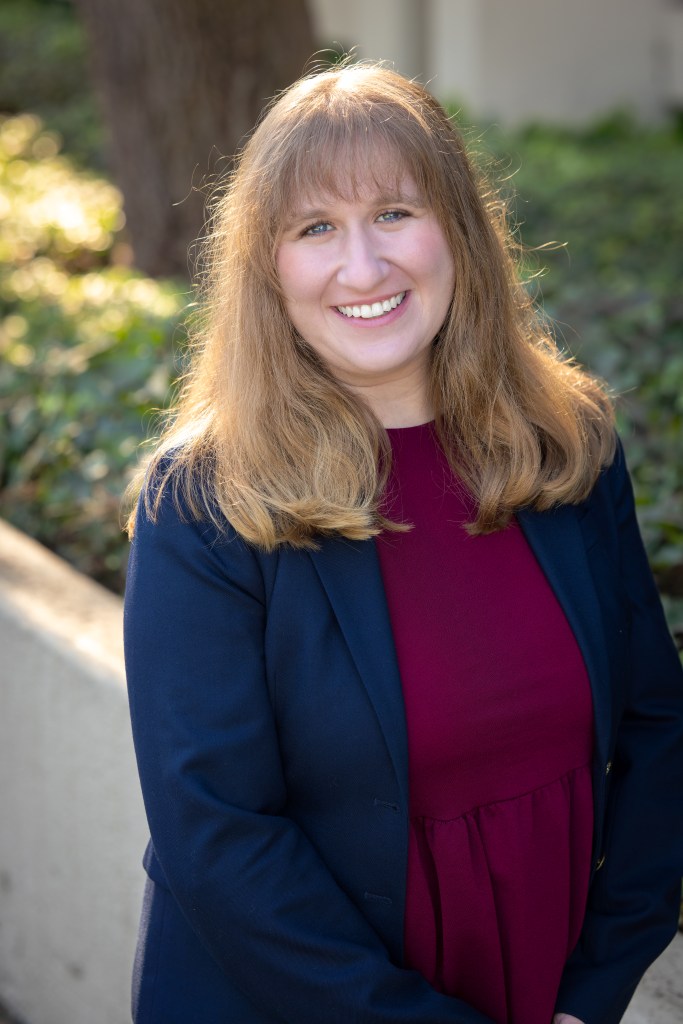
 Rabbi Leah Julian